Saturday, November 19, 2011

Prokhorovka Playtest Turn 2


This will be an ongoing record of my first playtest of my Prokhorovka (Kursk) scenario using the Field of Battle: WW2 (FOBWW2) rules from Piquet.  This is Turn 2, the Night turn of July 10, 1943.

Night turns are an interesting part of  FOBWW2.  Each day consists of 3 turns:  the AM turn, the PM turn and the Night turn.  A lot of action happens during the Day turns, but when the Night turn comes it's time to reorganize and repair the damage done during the day's fighting.

During the night turn the following rules change:
  • Initiative dice are DOWN 2.  So instead of rolling for cards with a German D12 vs. a Soviet D10, we have to roll a German D8 vs. a Soviet D6.  This means less chance for a large difference between the dice ( and less cards to act on) and a greater chance to tie the Initiative dice and end the turn early.
  • Movement die rolls are DOWN 2.  You normally roll for movement with your command die vs. a D6.  For every multiple of 3 you beat the D6 result by, the moving command can move an extra move segment.  So reducing the size of movement dice at night reduces the amount of movement units can make.
  • Units may make a redeployment move if they start at least 10" from the enemy.  They may redeploy anywhere on the table on a single Move card as long as they don't come closer than 20" to any enemy units.     
  • Fire combat is limited to 5" range.
  • Close assaults can only be done on the Close Assault card.  No hasty close assaults during Night.
  • No air support.
  • 5" visibility and halved visibility in terrain.
  • Units can dig in at night with a successful Engineering roll.
  • Truck-mounted units can mount up on their trucks at night.
  • Most importantly, the Night turn can end on a Morale card pulled by either player.  Out of the approximately 27 cards each player has in his deck, 3 of them are Morale cards.  So between the two decks, there are six more chances the Night turn will end early.
From the Soviet perspective, there are some things that can be achieved on this 10 July Night turn.  The Soviets have an infantry battalion and an entire motorized rifle brigade (53 MRB) arriving on the Night turn.

The infantry battalion has to enter on the eastern board edge (MAP ARROW 2), but I could declare that 53 MRB is travelling up the Psel River valley and have the brigade enter anywhere on the eastern 6 feet of the north board edge (MAP ARROW 1) with a slight delay of one Move card.  The advantage of this move is that the 53 MRB could garrison the Psel River villages along the north board edge when it enters the table.  The 99th Tank Brigade is barely holding onto Mikhailovka and Andreevka is completely unoccupied since its defenders were destroyed by German direct fire prior to the end of the PM turn.

Maintaining control of these Psel River villages allows the Soviets to continue to threaten the left flank of the Germans as they advance toward Prokhorovka.  The risk is that the Soviets won't get enough Move cards to bring the 53 MRB before daylight and the July 11 AM turn arrives.

The other potential move is to use the T-34 companies of the 169th Tank Brigade parked behind the Storozhevoe woods and launch a night attack (MAP ARROW 3) on the armored car companies of the 1st SS Recon Battalion position on the German right flank west of Storozhevoe.  The German T-34 tanks could cause some serious damage to the lightly armored German recon units and it might be an opportunity to cause some quick damage to the Germans.

While this aggressive attack is tempting, this would be a smarter attack to try during daylight hours.  Since Night reduces the armored command's movement die from a D8 to a D4, it's almost impossible for the tankers to get more than 1 movement segment on a Move card and they need at least 2 move segments to get close enough to see the Germans in the darkness.  Also, with the arrival of the the division's other PzGr Regiment, the 1st SS AT Bn, and the 1st SS Stug Bn on the morning of 11 July, the Soviet armored strike force would most likely be destroyed by the Germans before they could fall back to safety.  The Soviets just don't possess the command and control to launch these types of night operations without serious risks.

After assessing my options, I rejected the night tank attack as too risky.  I might attempt the attack if I could get a lot of cards and rolled 2 movement segments prior to launching the attack, but I'll wait and see.

I did declare the 53 MRB entering through the Psel River valley and onto the north board edge.  I'm willing to risk weakening my center to position such a strong threat along the left flank of the German avenue of approach.

SO WHAT HAPPENED?

First, I rolled the dice to check to see if SS Totenkopf and SS Das Reich made any progress on my flanks during the 10 July fighting.  Nope.  Big shocker there.  Thanks, jerks.

The Initiative die roll resulted in a German 7 vs. a Soviet 1 result.  6 cards!  I wasn't expecting that.

The Germans pulled a few Command and Control cards and did a great job repairing the tanks that were damaged the previous days' fighting.  Only the Tiger company was unsuccessful at replacing its losses.

The Germans then flipped a Move 1 Command card.  They moved a PG Battalion into the unoccupied village of AndreevkaPsel River village, Mikhailovka.


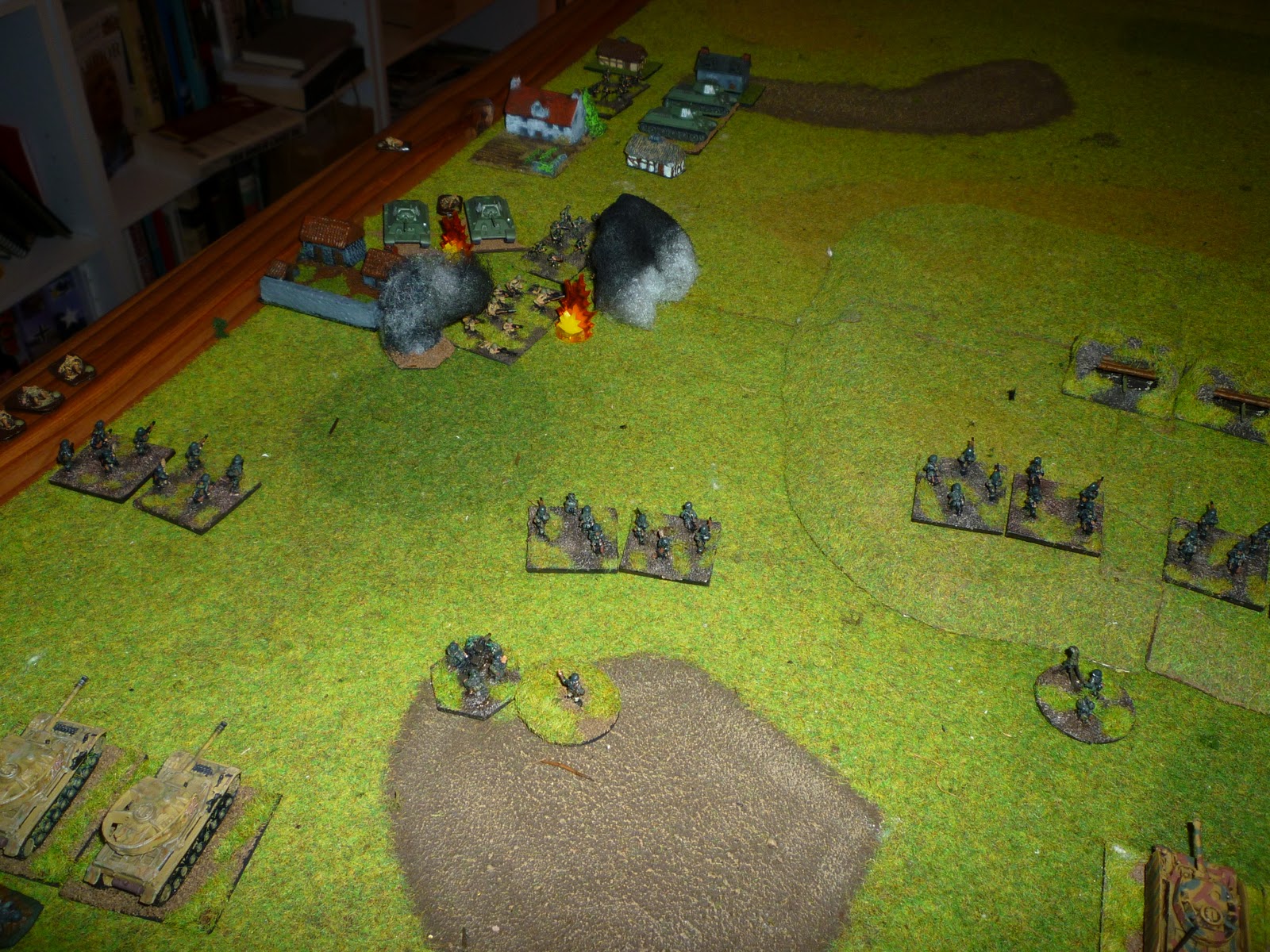
Another Move card allowed the Germans to move armor around the village and the single Soviet tank company defending Mikhailovka nervously listened as the sounds of armor came nearer.


The next card for the Germans was a Close Assault card.  The Germans geared up to assault Mikhailovka.  The surrounding German tanks conducted preparatory fire on the village before the Germans infantry were sent in.  The Soviet tanks fired back, but the German tank fire destroyed the Soviet defenders and the shattered Russian tankers fled from their defenses.  With no defenders, there was no close assault.  Instead the German infantry waited for the flames of the burning village to die down so they could occupy the ruins.

Now it was the Soviet turn to flip cards.  The first Soviet card flipped was the Firepower card, but with no visible targets, this didn't help them.  The next card was the MORALE CARD!!!!! ARRRGH!!  No Move card?!

The Night turn ended on the Morale card.

The Soviets were only able to bring on their single infantry battalion.  My decision to bring the 53 MRB onto the northern board edge meant that I'll have to wait until the 11 July AM turn to bring them on to the table.  Apparently the 53 MRB is stuck in congested traffic on the way to the front lines.  Hopefully, they'll show up soon.  In the meantime, someone will have to answer for this.  Commissar!!!

Wednesday, November 16, 2011

Kursk: Drive on Prokhorovka Scenario and OOB

I've had some requests for the scenario and order of battle for my Prokhorovka scenario, so I thought I'd post it here. You can also download a pdf of the scenario HERE, but you'll have to join the Piquet Yahoo group to get it. 
I'll offer a warning that this scenario will evolve as we playtest it.  It also requires a lot of miniatures to play it.

A good starter scenario is to just try the 10 July PM turn:

Victory Points are awarded to the Germans for the following objectives: Andreevka 3 VP, Hill 241.6 6 VP, Storozhevoe 4 VP.  At the end of the turn, subtract the German morale point losses from the total VP's.  If the end result is not negative and the Germans have captured at least one objective, the Germans win. 


Monday, November 14, 2011

Prokhorovka Playtest Turn1


This will be an ongoing record of my first playtest of my Prokhorovka (Kursk) scenario.  This is Turn 1, the PM turn of July 10, 1943.  The Germans would like to accomplish a few objectives in this turn:
  • In the center, seize Hill 241.6 from the 26th Tank Brigade by the end of the turn (nightfall).
  • Clear the 99th Tank Brigade out of the first two villages along the Psel River valley on the left table edge.
  • If possible, seize the town of Storovhezoe on the right flank. 
In Field of Battle World War 2 (FOBWW2), each side flips cards from a card deck to determine what their units are able to do during the turn.  Each turn is divided into initiatives and the number of cards per initiative is determined each time by the difference between opposed initiative dice (D12 for the Germans and D10 for the Soviets).  A turn ends when the initiative dice are tied or either players runs out of cards in his deck.

There are a variety of cards which can make up the deck.  Better armies have better cards in their decks.  I took photographs after a few cards were flipped already.


(ABOVE)  After a brief exchange of direct fire, both German commands rolled a "1" on a D12 on a Move card resulting in no movement for anyone!  Minefields, maybe? Finally, the Germans flipped the "Move 1 Command" card and advanced a battalion from the 1st SS PG Regiment toward Hill 241.6

(ABOVE)  The panzer grenadiers then used the Tactical Advantage card to increase their firepower and suppressed the entrenched Soviet anti-tank guns.
(ABOVE) Close-up on the grenadiers moving over the railroad embankment (Use your imagination, dammit!) with supporting armor.

(ABOVE) Another Move card finally allowed the Germans to roll well enough to make a general advance in the center.  The division's recon battalion moved against Storozhevoe on the right while a battalion of panzer grenadiers marched forward to clear the first Psel River village.

(ABOVE) Concentrated fire from the grenadiers managed to suppress the tanks and Soviet infantry defending the village.


(ABOVE) The Germans managed to kill most of the Soviet infantry in the 26th Tank Brigade defending Hill 241.6 and this used up all of the brigade's morale points.  When the Soviets flipped a Morale card, the brigade passed its first Morale check, but when this second Morale card was flipped by the Soviets, the brigade failed and routed (picked up). Much to the Germans' dismay, the defiant 99th Tank Brigade troops defending the village of Andreevka along the Psel line passed their Morale and grimly settled into the rubble (BELOW).


(ABOVE) The grenadiers get closer to the Psel villages and German artillery begins to pound the stubborn Soviet defenders.


(ABOVE) On the right flank, German panzer grenadiers infiltrated through the woods and began to flank Storozhevoe.  When the Germans flipped the Close Assault card, the German armored cars and recon troops poured fire into the town.  A company of recon troops and a company of panzer grenadiers assaulted the town and become involved in a vicious hand-to-hand fight with the Soviet motorized infantry.  The Soviets lost a full company of infantry, but the hardy Slavs drove the Germans reeling back out of the town.

(ABOVE) The Germans advanced onto Hill 241.6 and began to to tighten the cordon around Andreevka village.  After a sharp firefight, the defenders were finally liquidated and the Germans moved on to attack the next village in the Psel chain: Mikhailovka.


(BELOW) And then the Soviet defenders posted there began to enjoy the attention of the German artillery.


The Germans rolled great for their next Move cards and managed to advance well past Hill 241.6 in the center and down into the valley beyond it.  The Soviets did manage to drop some very effective artillery fire on one of the dismounted panzer grenadier companies and forced the infantry to fall back and take cover (BELOW).


(ABOVE) as the artillery fell and after the artillery hammered the exposed Germans (BELOW).


At this time, the PM Turn ended and the Night turn began.  The Germans made excellent progress at the cost of only 7 morale points.


(ABOVE) German progress on the right flank.  The recon battalion has been stymied by the Soviet infantry defending Storozhevoe.  In the center (BELOW), the German grenadiers and tanks have made excellent progress, but the Soviet 99th Tank Brigade is still stubbornly hanging on to Mikhailovka village along the Psel River on the left flank.  

The 1st SS Panzer Grenadier Division has slightly exceeded its historical progress at this point in time.  

On the left flank, the Psel River villages were hard for the Germans to clear in the real battle.  Also, in this scenario, if Totenkopf Division has difficulty advancing on the left of the wargame table, the Germans will have to garrison those villages to prevent them from being re-occupied by reinforcing Russians.

In the center, the Germans have made good progress, but they now face the dug-in 9th Guards Airborne Division, AT batteries, minefields, an anti-tank ditch and supporting heavy armor across the valley . 

On the right flank, the Germans are outside of Storozhevoe which matches their historical progress.

LAH 1st SS Division Morale Points Left:   41/48
There's a lot of game left.


(BELOW)  The Soviets still have the T-34 companies of the 169th Tank Brigade safely in reserve behind the Storozhevoe woods.  What should we do with them?  Make a night attack and attempt to butcher the German recon battalion or save them to threaten the right flank of the German panzer regiment as it advances along the railroad embankment?

Next post will be the July 10, 1943 Night turn.  During playtest breaks, I'll be painting Marders, Stugs, and more Panzer IV's for the Germans.  I'm also going to add tank commanders for the tank command stands, tank riders to spice up the plastic T-34's, and better terrain to represent the railroad embankment and some of the towns.

Saturday, November 12, 2011

Brief Kursk Book Review: Demolishing the Myth


 "Demolishing the Myth" is a book that I've been waiting to get my hands on for a few months now.  As those who follow my blog know, I have been deeply involved in designing a Field of Battle: World War II (FOBWW2) scenario to simulate the LAH 1st SS Panzergrenadier Division's attempt during the Kursk battle to capture Prokhorovka Station.  FOBWW2 is a Piquet-family game that puts you in the seat of a division commander.  The smallest units are companies.

"Demolishing the Myth" was written by Valeriy Zamulin in 2005.  Zamulin was the Director of Research at the Prokhorovka Museum and only recently has this book become available in English.  Stuart Britton did an excellent job translating this book to English and the transition from Russian to English is flawless.  The book offers a Soviet perspective of the fighting around Prokhorovka and gives a fresh look at a battle that previously has been described mostly from the German point of view.

The book is 630 pages and each page has a nice, glossy feel to it.  The book is extremely heavy and I actually weighed my copy in at 4 pounds!  It contains 38 contemporary color photos taken by the author of viewpoints from the battlefield (BELOW).  Black and white photographs of action scenes and important leaders are present throughout the book.


 There is an excellent map section (9 maps) that clarified for me the different units involved in this very confusing battle (BELOW).

 And there are tons and tons of charts recording the strengths and casualties by vehicle type and troop rank of the German and especially the Soviet units involved (Example BELOW).  Everything you wanted to know to develop a wargaming scenario.


The author writes from a Soviet perspective and often refers to the Germans as "the enemy" and Soviet units as "our"  units, but I hardly cared.  I was too blown away by the insight he gives into the different brigades, the conflicts between the leaders, the mistakes made and heroes proven on the battlefield.  Zamulin combines tactical descriptions of the action during the battle with personal accounts of the men who fought there.

I was particularly moved by a passage where the book described  how the uniforms of the tank crews became soaked with fuel and grease while they worked on their tanks.  Then when they entered combat, direct fire and artillery would hit the T-34 and often puncture the oil and gas tanks.  Gas would drain into the interior of the tanks and soak the crews.  Only the slightest flame or spark would  ignite the uniforms of these brave crews.  Horrifying.

I recommend this book greatly, but I will warn buyers that it is very focused on the Prokhorovka portion of the Kursk battle.  If you're into Prokhorovka like I am, this book will become your bible.  When it arrives, you will thumb through it like a hungry wolf, trying to decide which chapter to devour first.

Demolishing the Myth Amazon Link

So using this new knowledge, I made some adjustments to my own "Drive on Prokhorovka" scenario.  I will post in a few days on this current play test of the scenario.

(BELOW) Germans prepare their initial assault on Hill 241.6.  Prokhorovka is on the horizon.   I added the small villages along the Psel valley to the left of the table.  The 99th Tank Brigade is now ensconced in those villages and the 26th Tank Brigade is on Hill 241.6.  The village of Storozhevoe is tucked into the woods now (defended by the 169th Tank Brigade) and the rail line is now curved.


(BELOW) Dead German markers ready for deployment, sir!

 (BELOW)  Only half of the Germans are deployed!  The rest show up on the next morning.


(BELOW) I've started using these neat Litko explosion markers for suppression and to mark when a unit was eliminated...I'm very happy with them.   I always try to avoid using beads and other markers to represent things on the table.  I'm now using smoke for unloaded, the explosions for suppression, and dead guys to represent stand losses on both sides.

 (BELOW) The German dismounted panzergrenadiers benefit from the Superior Firepower card.  Two Soviet infantry units are destroyed and another one is suppressed.

(BELOW) A normal Firepower card results in general fire from the tanks and infantry of 1st LAH Division.  More suppressions and casualties are the result.

(BELOW) This panzergrenadier group thought it might be able to clear out the 99th Tank Brigade units along the  Psel River, but just like their historical counterparts, the Soviets responded with a hail of effective fire, suppressing all of the infantry in the group.  Not so easy, eh, Hitlerites!?

(BELOW) A German Command and Control card drops a spotting round on the Soviets and the on the next card, in drops the Nebelwerfers!!!  Stalin's organs eat your heart out!!